
Bag terms explained simply
GSM, gusset, Pantone, FOB: every word you will see in a bag quotation, explained in one or two plain sentences. Useful whether you are buying bags for the first time or checking a specification.
From measuring to shipping.
Sizes and measuring
- Width (W)
- The side-to-side measurement of the bag, laid flat.
- Height (H)
- From the bottom edge of the bag to the top opening.
- Gusset (G)
- Extra fabric at the base, and sometimes the sides, that gives a bag depth so it can stand up and hold boxes. A flat bag has no gusset.
- Handle length
- The full length of one handle, end to end.
- Handle drop
- The distance from the top of the handle, held up, to the bag opening. A longer drop lets the bag go over the shoulder.
- Centimetres and inches
- 1 inch = 2.54 cm. Every size on our site is shown in both.
- Tolerance
- The small difference allowed between the ordered size and the finished bag. It is agreed with your sample before bulk production.
- Reference code
- Our short code for each example size, such as TX-TOTE-35x40 (a tote 35 cm wide and 40 cm high). Quote it in an enquiry or purchase order instead of writing out the size.
Fabrics
- GSM
- Grams per square metre: how heavy the fabric is. Higher GSM usually means a heavier, firmer fabric and a higher price; strength also depends on the weave and stitching.
- oz (ounces)
- Fabric weight in ounces per square yard, common in the USA. 1 oz per square yard is about 34 GSM.
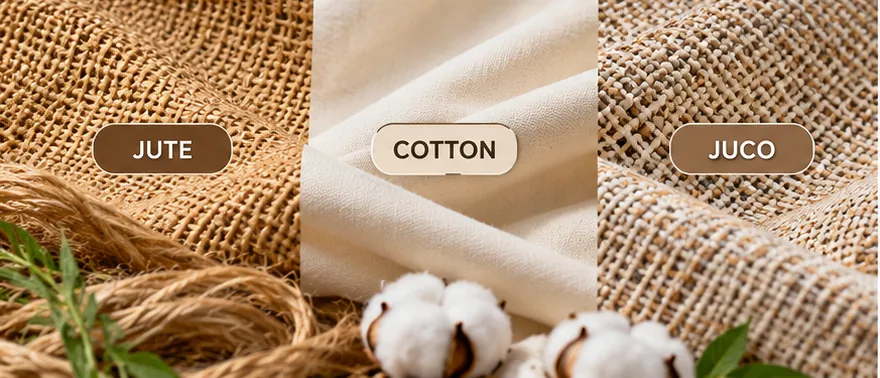
- Cotton
- Natural woven fabric. Light to mid weights give the sharpest print.
- Canvas
- A heavier, closely woven fabric that holds its shape; ours is cotton canvas. There is no fixed GSM cut-off, but in the bag trade cotton from about 8 oz (around 270 GSM) is commonly sold as canvas.
- Organic cotton
- Cotton grown under organic farming rules and certified under standards such as GOTS.
- Recycled cotton
- Cotton fibre recovered from textile waste and certified under standards such as GRS.
- Jute
- A strong natural plant fibre with a rustic look, grown mainly in India and Bangladesh.
- Hessian
- Plain-woven jute fabric. In North America it is often called burlap.
- Juco
- A blend of jute and cotton: the strength of jute with a smoother surface for finer print.
- Polycotton
- A blend of polyester and cotton: economical, light and easy to print.
- Polyester
- A light, strong synthetic fabric, used for drawstring, sports and foldable bags.
- Non-woven
- Fabric made by bonding fibres together instead of weaving them.
- PLA
- Polylactic acid, a material made from plant starch such as corn. PLA non-woven can be compostable in industrial composting facilities, depending on its certification.
- Felt
- A dense fabric made by pressing fibres together, used for gift and storage bags.
- Lamination
- A thin film bonded to the fabric for water resistance. On our jute and juco bags it is applied on the inside only.
- Natural, bleached, dyed
- Natural keeps the fibre's own colour; bleached is lighter; dyed is coloured to a shade you choose.
Colour and printing
- Pantone
- A numbered colour system, so you and the factory work to the same target shade. The match is approved on a lab dip or sample, because fabric and dye affect the result. Example: Pantone 19-4052 TCX, Classic Blue.
- Screen print
- Ink pressed through a fine mesh screen, one screen per colour. Best for bold logos in one to four colours.
- Digital print
- Full-colour printing directly from your file. Suits photos, gradients and many colours.
- Embroidery
- The logo is stitched into the fabric with thread. A premium finish.
- Woven label
- A small fabric label with your brand woven in, sewn onto the bag.
- Vector artwork
- A logo file made of shapes and lines (AI, EPS, PDF or SVG) that stays sharp at any size. Preferred for screen printing.
- Mockup
- A picture of how your design will look on the bag. You can make one in our Bag Mockup Studio.
Construction
- Hem
- The folded and stitched edge at the top opening.
- Box-and-cross stitch
- A square of stitching with a cross through it, where the handle joins the bag, to spread the load.
- Double stitching
- Two rows of stitching on the same seam for extra strength.
- Webbing
- A flat, strong woven strap used for handles.
- Lining
- A second fabric layer sewn inside the bag.
- Drawstring channel
- The folded tunnel at the top of a drawstring bag that the cord runs through.
Certifications
- GOTS
- Global Organic Textile Standard: certifies organic fibre content and responsible processing, including chemical inputs, through the supply chain.
- GRS
- Global Recycled Standard: certifies recycled content and responsible production.
- ISO 9001
- An international standard for quality management systems; the 2015 edition is ISO 9001:2015.
- ISO 14001
- An international standard for environmental management systems; the 2015 edition is ISO 14001:2015.
- Jute Mark India (JMI)
- A mark from the Government of India's National Jute Board that identifies genuine jute products made in India.
- Sedex and SMETA
- Sedex is a platform for sharing ethical supply-chain data; SMETA is its social audit. A SMETA audit is an audit, not a certificate.
Ordering and shipping
- MOQ
- Minimum order quantity: the smallest number of bags made per design. It depends on bag size, fabric and colour.
- Sample
- One finished bag made to your specification for approval before bulk production.
- Lead time
- The time from your approval to the goods being ready.
- Spec sheet
- A one-page summary of the bag: size, fabric, handles, colour and print. Each of our size pages prints as one.
- Tech pack
- A fuller set of technical documents for a product: drawings, measurements, materials, artwork placement and labelling.
- Incoterms
- Standard trade terms published by the International Chamber of Commerce (ICC); the current version is Incoterms® 2020. They state who pays for each step of shipping and when the risk passes to the buyer, always with a named place, for example FOB Kolkata.
- EXW (Ex Works)
- The buyer collects the goods from the seller's premises and handles everything after that.
- FCA (Free Carrier)
- The seller hands the goods to the buyer's carrier at an agreed place, such as a container terminal, cleared for export. The ICC recommends FCA rather than FOB for container shipments.
- FOB (Free On Board)
- The seller delivers the goods on board the ship at the port of loading. From there the buyer pays and carries the risk. Used for sea freight.
- CIF (Cost, Insurance and Freight)
- The seller pays freight and insurance to the destination port, but the risk passes to the buyer once the goods are on board at the port of loading. Used for sea freight.
- DAP (Delivered At Place)
- The seller delivers to an agreed place in the buyer's country. The buyer pays import duties and taxes.
- DDP (Delivered Duty Paid)
- The seller delivers to the agreed place and also pays import duties and taxes.
- HS code
- The customs classification number used worldwide to identify a product for duties and paperwork.
- Commercial invoice
- The seller's bill for the goods, used by customs.
- Packing list
- A list of what is in each carton: quantities, weights and sizes.
- Certificate of origin
- A document stating the country where the goods were made.
- GST
- India's Goods and Services Tax. It is charged on our domestic sales in India as applicable under current rules.
- Transaction certificate
- A document from the certification body that confirms a specific shipment of certified goods (for example GOTS or GRS). It is issued per order, when certified goods are ordered.
Common questions about bag terms.
What does GSM mean on a bag?
GSM means grams per square metre, the weight of the fabric. A higher GSM usually means a heavier, firmer fabric; strength also depends on weave and stitching.
What is a gusset on a bag?
The extra fabric at the base, and sometimes the sides, that gives a bag depth so it can stand up.
What is the difference between FOB and CIF?
With FOB the buyer pays the sea freight from the port of loading; with CIF the seller pays freight and insurance to the destination port. In both, the risk passes to the buyer once the goods are on board.
Tell us what you need.
Product, quantity and destination is enough to start. We review your requirement and reply with a quotation.