
Tote bag design trends for 2027: seven directions worth knowing
Design trends move slower on bags than on phone screens, which is good news. A direction you pick now will still look right in two years.
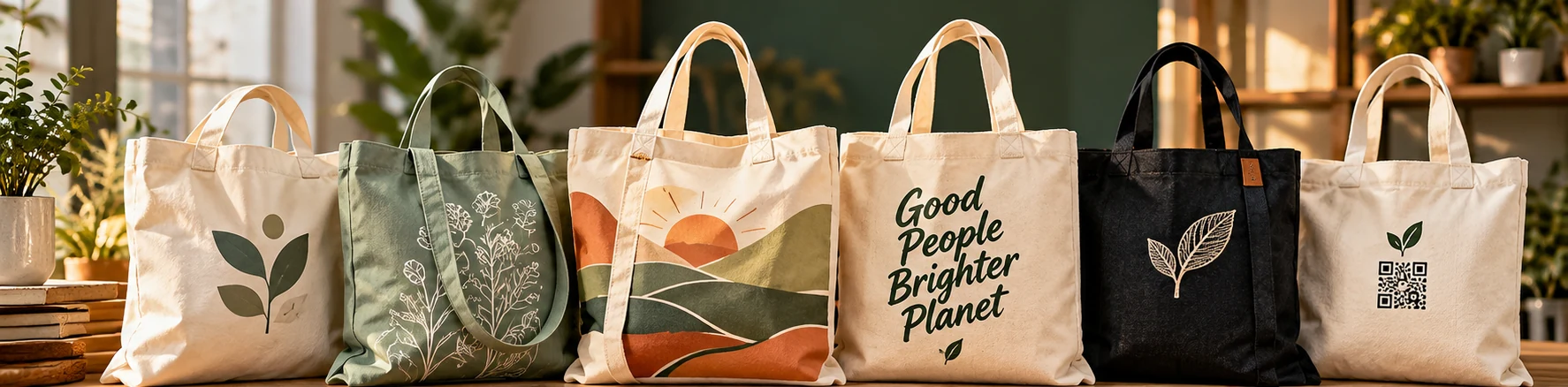
In this guide: Trend 1: Minimal logos with plenty of white space · Trend 2: Illustrated and artist-led artwork · Trend 3: Earthy palettes and natural tones · Trend 4: Bold typography and short messages · Trend 5: Functional details · Trend 6: Texture, embroidery and woven labels · Trend 7: Sustainability stories and QR codes · How to apply these trends to your next order · Working with the right production partner · Questions buyers ask us
Trend 1: Minimal logos with plenty of white space
One small logo, off-centre, with most of the bag left plain. It photographs well, costs less to print (fewer colours, smaller area), and ages better than a bag covered edge to edge.
Trend 2: Illustrated and artist-led artwork
A commissioned illustration rather than a straight logo. Brands are increasingly working with illustrators for a one-off design, which also gives the bag a reason to be shared rather than just carried.
Trend 3: Earthy palettes and natural tones
Sage, clay, cream, ochre. Colours that sit well against natural jute and cotton rather than fighting it. They also photograph consistently in different lighting, which matters if your bag ends up in customer photos.
Trend 4: Bold typography and short messages
A single word or short phrase, set large. Works well on jute, where fine detail struggles but bold shapes don't. Keep it to one idea; a bag is not a billboard.
Trend 5: Functional details
An inside pocket, a zip top, a bottle sleeve built into the gusset. Small practical additions that turn a tote from a giveaway into something people choose to carry daily.
Trend 6: Texture, embroidery and woven labels
Less reliance on flat print, more on embroidery and woven labels for a tactile, premium feel. This pairs particularly well with juco and heavier canvas, where the texture is part of the appeal.
Trend 7: Sustainability stories and QR codes
A small printed tag or QR code linking to the bag's story: the fabric, the certification, how it was made. Buyers increasingly want to check a claim rather than just read it, so make sure whatever the code links to is accurate and current.
How to apply these trends to your next order
Pick one or two directions rather than all seven at once; a bag trying to do everything usually does nothing well. Start with your fabric (see our guide on canvas vs cotton), then choose a design direction that suits its texture and your print method.
Working with the right production partner
A good manufacturer will tell you honestly which trend suits your fabric and budget, rather than agreeing to everything. Send your idea, even roughly sketched, and ask what's realistic on a sample before committing to bulk.
If we're picking a favourite out of the seven, it's trend 6: texture and woven labels over flat print. It's the one that photographs least excitingly on a mood board and sells best in person, once someone's actually holding the bag.
Questions buyers ask us
What tote bag design trend works best for jute?
Bold typography and minimal logos suit jute's open weave. Fine illustrated detail prints better on cotton or juco.
Are minimal designs cheaper to print?
Often yes. Fewer colours and a smaller print area usually cost less, particularly with screen printing.
What's a practical functional detail to add to a tote?
An inside pocket, a zip top, or a bottle sleeve in the gusset are popular additions that add real use without much extra cost.
Should I try a trend before ordering in bulk?
Yes. Order a sample first and check the design on the real fabric before committing to a bulk quantity.
Tell us what you need.
Product, quantity and destination is enough to start. We review your requirement and reply with a quotation.